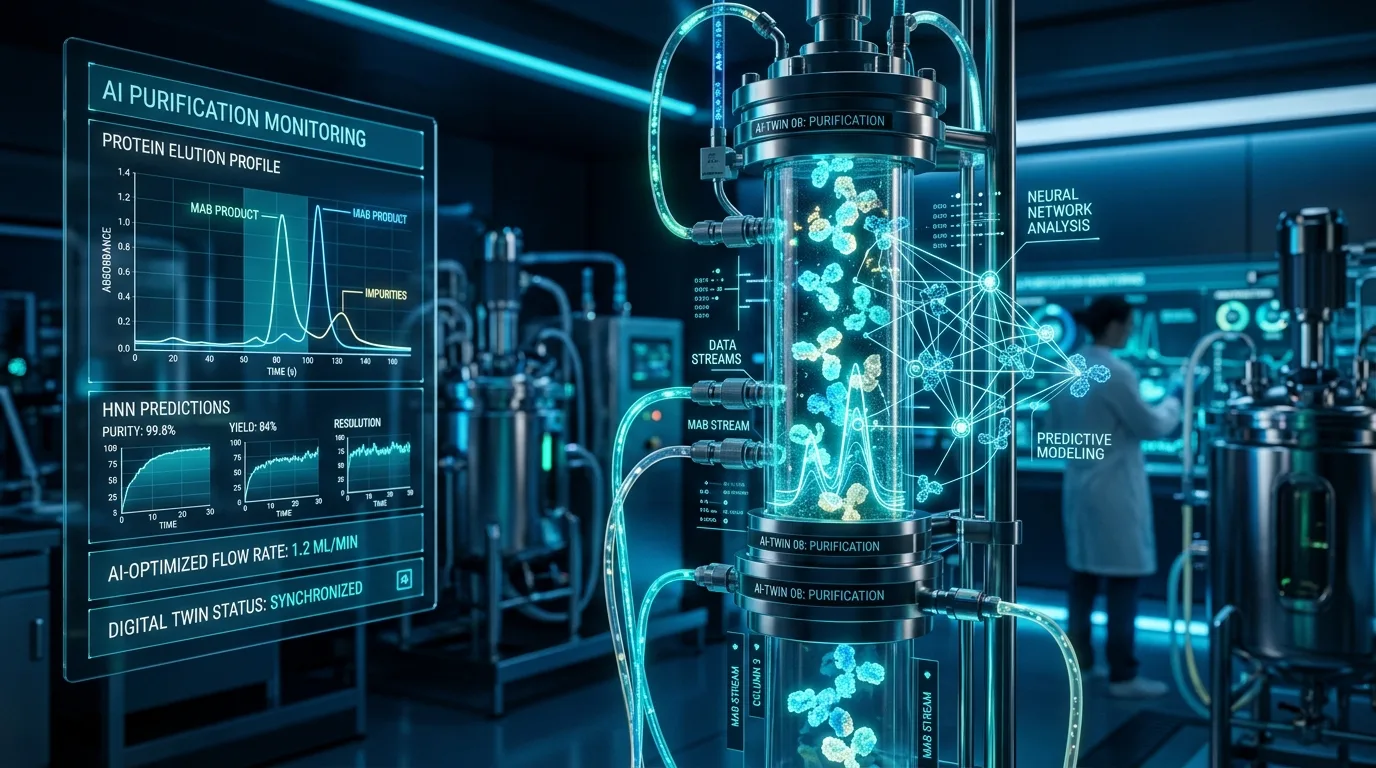
While upstream bioprocess development has long leveraged machine learning for media optimization and bioreactor control, downstream processing (DSP) is currently experiencing its own digital transformation. From harvest clarification to final formulation, Artificial Intelligence (AI) and Machine Learning (ML) are unlocking unprecedented efficiencies in monoclonal antibody (mAb) purification, accelerating process development timelines and maximizing commercial batch yields.
Hybrid Modeling: Mechanistic Physics Meets Deep Learning
Purely mechanistic chromatography models (such as the General Rate Model and Steric Mass Action isotherm) offer high predictive power based on fluid dynamics and mass transfer principles, yet they often struggle with complex multi-component mAb feedstocks containing aggregates and host impurities. By contrast, hybrid modeling couples fundamental physics with Artificial Neural Networks (ANNs). The AI layer captures non-linear binding behaviors and competitive adsorption kinetics that standard differential equations miss. This enables in-silico screening of elution gradients and column dimensions, reducing wet-lab resin scouting experiments by over 70%.
Digital Twins & Adaptive Peak Cutting
During large-scale Ion Exchange (IEX) and Hydrophobic Interaction Chromatography (HIC), separating closely related product variants—such as charge isomers, acidic species, or high molecular weight (HMW) aggregates—demands razor-thin peak cutting precision. Machine learning models trained on continuous multi-wavelength UV/Vis and dynamic light scattering (DLS) data act as real-time Digital Twins. Instead of relying on static absorbance thresholds that risk discarding valuable monomer or co-eluting aggregates due to batch-to-batch titer fluctuations, AI algorithms dynamically adjust fraction diversion valves in real time to optimize both recovery yield and purity.
Predictive Maintenance: Resin Lifetime & TFF Fouling
Downstream consumables represent significant operational expenditures. Protein A chromatography resins are typically reused for 100–200+ cycles in GMP suites, but unpredictable ligand leaching and foulant buildup can cause premature capacity loss. Predictive ML algorithms analyze pressure-flow curves, transition analysis (HETP / asymmetry factor), and delta-pressure across cycles to forecast exact resin degradation points. Similarly, in Tangential Flow Filtration (TFF/UF-DF), Recurrent Neural Networks (RNNs) forecast transmembrane pressure (TMP) drift and critical flux transitions, recommending optimal cleaning-in-place (CIP) interventions before irreversible membrane fouling occurs.
Regulatory Harmony & The Future in Canada
As Health Canada, the US FDA, and the EMA develop standardized frameworks for AI/ML in biopharmaceutical manufacturing (aligned with ICH Q10 and Q13), explainable AI models with clear parameter bounds are becoming audit-ready. For Canada's rapidly growing biomanufacturing hubs in Ontario and Quebec, integrating AI with downstream purification bridges the gap between laboratory-scale agility and commercial GMP manufacturing excellence.
References
- Narayanan, H., et al. (2020). Digital Twins in biopharmaceutical manufacturing: Toward data-driven and mechanistic hybrid modeling. Current Opinion in Biotechnology, 65, 81–89. doi:10.1016/j.copbio.2020.02.002
- Papathanasiou, M. M., et al. (2019). Advanced model-based control strategies for the intensification of downstream bioprocesses. Computers & Chemical Engineering, 130, 106541. doi:10.1016/j.compchemeng.2019.106541