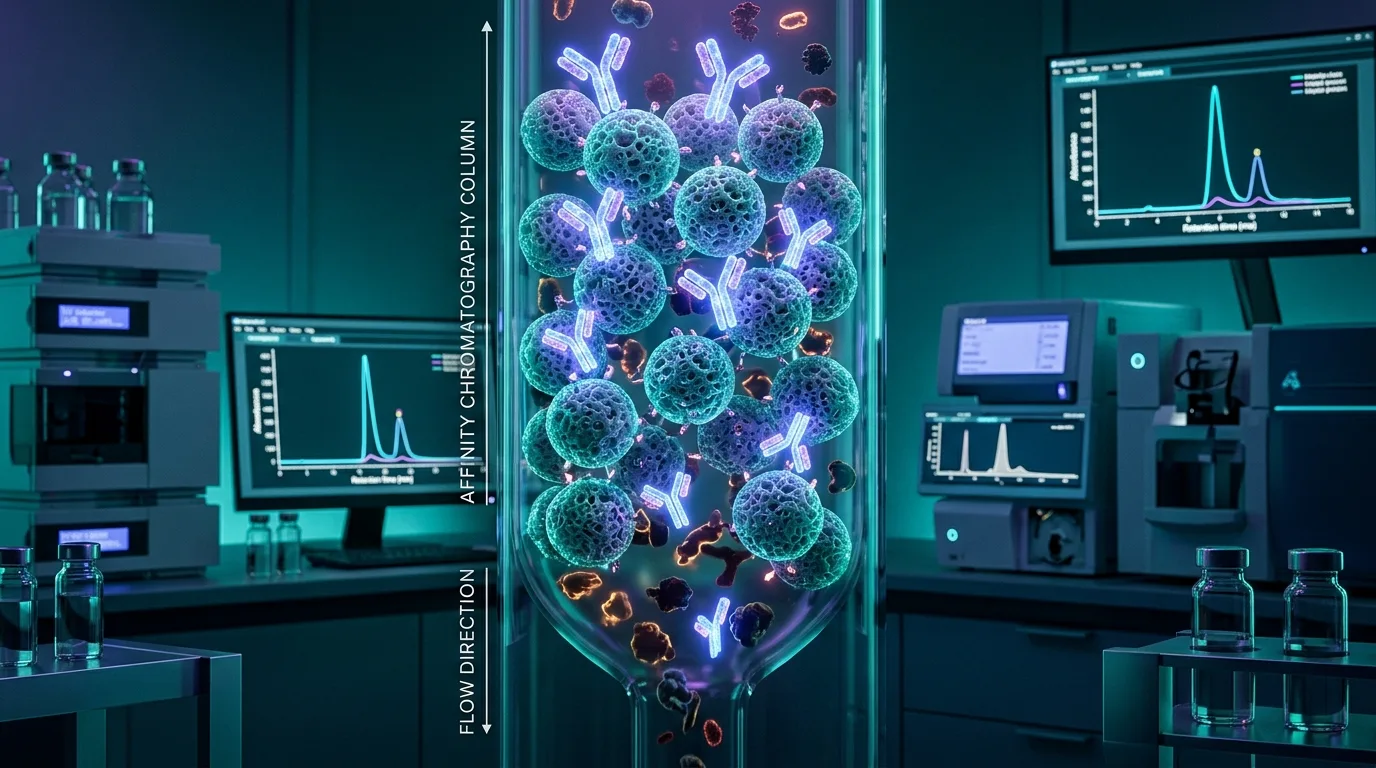
In biosimilar and biotherapeutic manufacturing, residual Host Cell Proteins (HCPs) represent a critical class of process-related impurities. Even trace amounts (<100 ppm, and frequently <10–20 ppm required by regulatory dossiers) can trigger severe anti-drug immunogenicity, degrade drug product stability through residual enzymatic activity, or cause adjuvant-like inflammation in clinical trials.
High-Risk Persistent "Hitchhiker" HCPs
While standard downstream workflows (Protein A affinity capture followed by Anion and Cation Exchange chromatography) efficiently clear over 99% of total host impurities, certain problematic proteins—such as Phospholipase B-Like 2 (PLBL2), Clusterin, and Serine Proteases—co-purify by directly hitchhiking on the target monoclonal antibody through hydrophobic or electrostatic interactions. Enzymatically active lipases can slowly hydrolyze polysorbate 20 and polysorbate 80 surfactants in finished vials, causing visible particle precipitation and compromised shelf life.
Advanced Multimodal & Orthogonal Analytics
Overcoming persistent HCP clearance requires tailored wash regimens during affinity capture (incorporating hydrophobic modifiers or amino acid additives like arginine and caprylate) coupled with multimodal (mixed-mode) chromatography resins like Capto adhere or MEP HyperCel. Crucially, analytical development must expand beyond generic polyclonal ELISA assays by implementing orthogonal 2D-LC-MS/MS (Mass Spectrometry) to identify, track, and guarantee the absolute removal of specific high-risk HCP species throughout process validation.
References
- Vanderlaan, M., et al. (2015). Hamster phospholipase B-like 2 (PLBL2) co-purification with therapeutic monoclonal antibodies. Biotechnology and Bioengineering, 112(11), 2261–2274. doi:10.1002/bit.25642
- Wang, X., et al. (2018). Host cell proteins in biopharmaceutics: Detection, characterization, and risk assessment. Biotechnology and Bioengineering, 115(8), 1932–1947. doi:10.1002/bit.26712