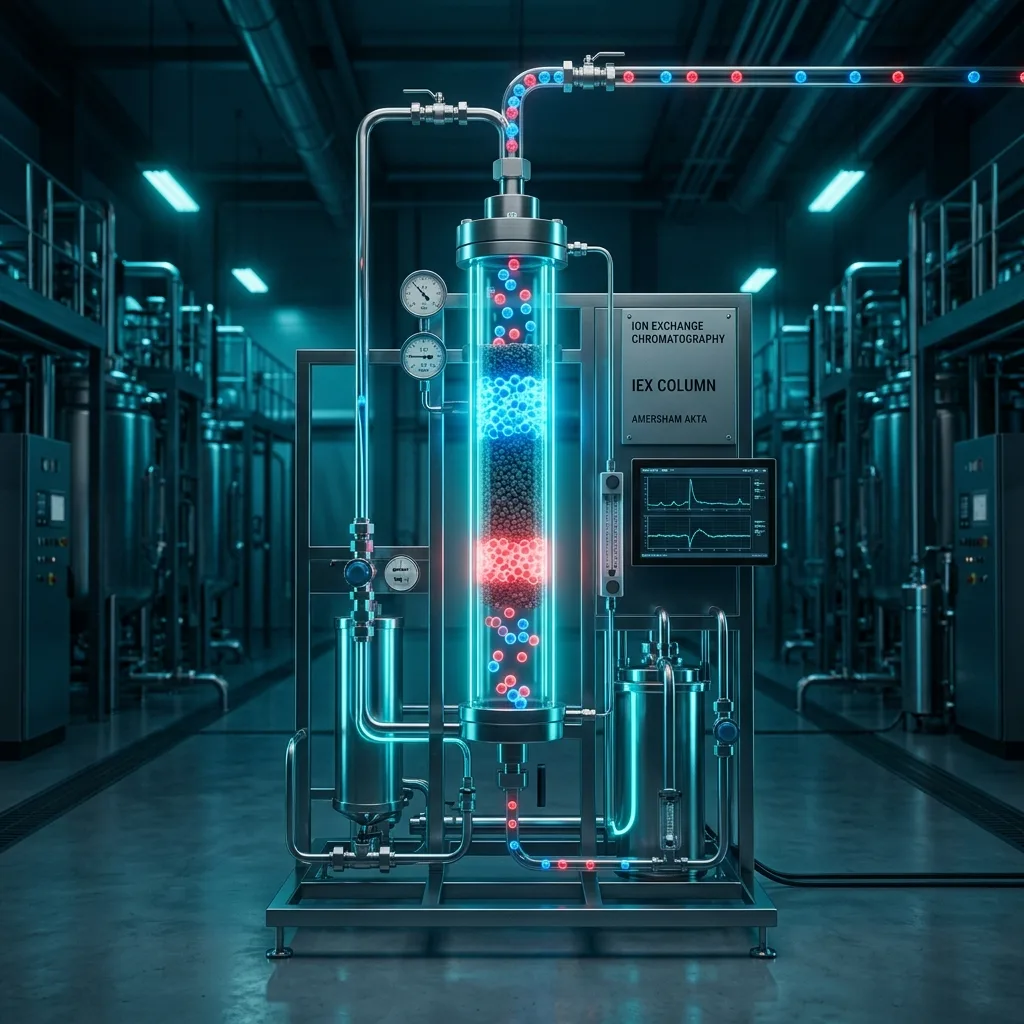
Ion Exchange (IEX) chromatography remains the workhorse of downstream polishing for monoclonal antibodies and recombinant proteins. Whether operating in bind-and-elute mode (typically Cation Exchange, CEX) to clear product-related impurities like high molecular weight (HMW) aggregates, or in flow-through mode (typically Anion Exchange, AEX) to clear process-related impurities like host cell DNA and endotoxins, IEX is critical for meeting final GMP quality specifications.
Buffer Preparation and Conductivity Control
However, scaling up IEX from bench-top to commercial manufacturing presents significant engineering challenges. A major hurdle is the precise preparation of large volumes of buffers. IEX resins are exquisitely sensitive to slight variations in conductivity and pH. In a commercial setting, formulating thousands of liters of buffer—often using in-line dilution—requires highly accurate mass flow meters and rigorous mixing validation. Even a 0.5 mS/cm deviation in elution buffer conductivity can drastically shift the elution profile, leading to the co-elution of aggregates or significant product loss.
Scale-up and Column Packing
Furthermore, column packing at scale dictates process success. Maintaining the correct compression factor and understanding the pressure-flow curve of the resin are essential to prevent bed channeling or premature pressure over-shoot. Modern downstream engineers must leverage high-throughput screening (HTS) to optimize gradients and step elutions in scale-down models, ensuring that the transition to large-scale GMP manufacturing is both seamless and robust.
References
- Fekete, S., et al. (2015). Ion-exchange chromatography for the characterization of biopharmaceuticals. Journal of Pharmaceutical and Biomedical Analysis. doi:10.1016/j.jpba.2015.02.037
- Staby, A., et al. (2006). Comparison of chromatographic ion-exchange resins. Journal of Chromatography A. doi:10.1016/j.chroma.2006.02.060